CREATED FUTURES

Created Futures Research · CR-2026-01 · November 2026

The future of
creative education

How AI, access and industry demand are reshaping creative-tech careers, and what a national skills pipeline for under-represented young people should look like.

By Rob Pepper. Supported by the Hg Foundation. Drawn from more than 25 in-depth expert interviews, survey data and desk research.

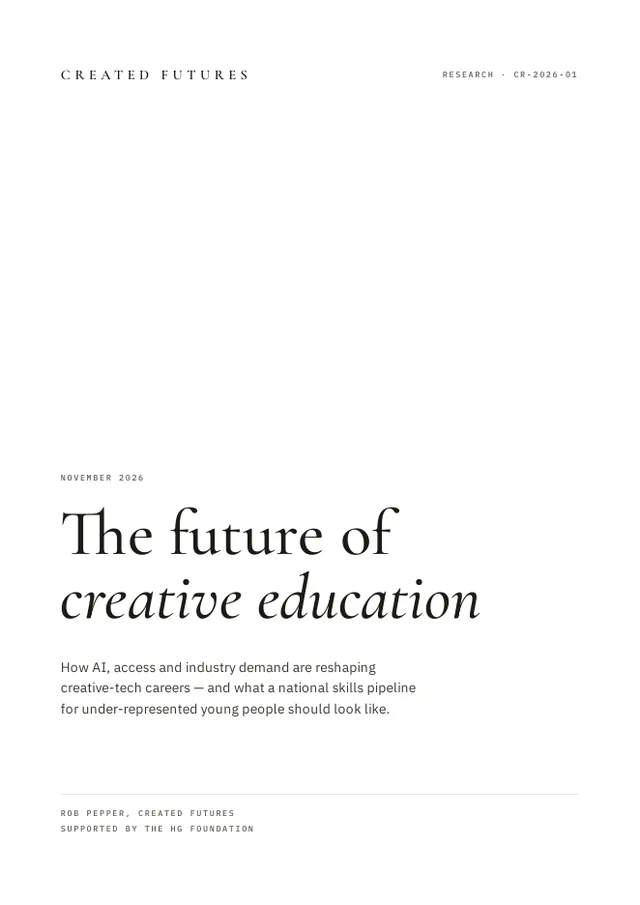
Cover of the report The future of creative education

“If creativity loses institutional support while AI education accelerates, are we building capability without imagination?”

Rob Pepper, from the foreword

Key figures

£145.8bn

creative industries GVA in 2024, 5.5% of the UK economy

60.3%

real growth since 2010, against 24.3% for the UK economy

28%

of creative workers are self-employed, twice the UK rate of 14%

51.7%

of creative GVA is made in London, with a further 16.1% in the South East

Source: DCMS Economic Estimates (Annual GVA 2024, provisional; Regional GVA 2023; Employment, April 2024 to March 2025).

Four headline insights

What the research found

01

Roles and skills are rapidly diversifying

Creative-tech roles now span virtual production, VFX, game design, XR, digital fashion and AI-assisted content. Employers want “50–50 brain” talent: creative intuition, technical fluency and commercial sense together. Most training is still siloed.

How we are responding

Our courses and tools put making and business side by side: artists learn their craft and, on the same platform, price, show and sell their work.

02

AI is a double-edged catalyst

Generative tools automate routine tasks and create new roles, but demand judgement on ethics, IP and human oversight. Up to half of tasks in many creative workflows are likely to be augmented rather than replaced.

How we are responding

We are AI-native in how we build, and use AI to give feedback where it helps, such as bowling analysis, while people own their work and choose when AI is used.

03

Barriers to training and progression are significant

Under-represented groups face economic, geographic, cultural and structural barriers: the cost of equipment and unpaid internships, London-centric clusters, network hiring and fragmented pathways.

How we are responding

Online first and priced for each country, with a free course for young people, Create Your Future, and schools able to take part under proper safeguarding.

04

There is a major opportunity for targeted intervention

The best opportunities sit where growth and skills shortages overlap: virtual production and VFX, gaming and immersive media, digital design and fashion technology. Employer-designed curricula, wrap-around support and modular training improve outcomes.

How we are responding

We are starting with a focused pilot rather than a large institution, and working with the Hg Foundation on what comes next.

The blueprint

A pipeline from first spark to career

Hybrid, modular and AI-supported learning, with employer-set briefs and stackable micro-credentials.

Ages 11 to 18

Outreach

School workshops, creative tech clubs and online resources.

Ages 18 to 25

Skills

Courses blending art, design, coding and production, with bursaries and mentors.

21 and over

Employment

Micro-credentials and part-time programmes for reskilling and progression.

For life

Alumni

Graduates return as mentors and collaborators.

This is landscape and scoping research, not a funding plan. Cost, employer commitment and where a new offer is genuinely additive are open questions our ongoing research will answer.

Inside the report

Eight chapters

Get the full report (PDF)
  1. 01Executive summaryThe findings, in brief.
  2. 02Context and objectivesWhy this research exists, and what it set out to answer.
  3. 03The creative tech landscapeMapping a £146bn economy in flux.
  4. 04How AI is reshaping creative workAutomation, augmentation, and the roles being born in between.
  5. 05Capabilities for the future workforceWhat talent needs to know, make and lead.
  6. 06Barriers to entry and progressionWhere talent is lost, and why.
  7. 07Opportunity and provision mappingWhere to intervene, and who with.
  8. 08Programme blueprintThe model, built from the evidence.

Get the report

Read the full report

Leave your email and your download will start straight away.

We keep your details so we know who is reading our research. We will only email you if you tick the box above. See our privacy notice.